PEX Fittings: Types, Sizes, Standards & Connection Methods (Engineer’s Guide)
PEX Tubing Basics Every Fitting Selection Starts With
Before choosing PEX pipe and fittings (or any PEX tubing fittings), the engineer needs to understand the tube itself. PEX is produced by cross-linking high-density polyethylene, which turns a thermoplastic into a semi-thermoset material with far better temperature, pressure and creep performance. Three manufacturing methods are recognised:
| PEX Type | Cross-Linking Method | Typical Degree of Cross-Link | Key Characteristic | Common Brands |
|---|---|---|---|---|
| PEX-A | Peroxide (Engel method), during extrusion | ~70–85% | Most flexible; thermal “shape memory” allows cold expansion; kinks repairable with heat | Uponor AquaPEX (formerly Wirsbo), Rehau, SharkBite PEX-A |
| PEX-B | Silane (moisture cure), after extrusion | ~65–70% | Stiffer, economical, high chlorine resistance; used mainly with crimp/clamp fittings | Zurn PEX, Viega PureFlow tubing, SharkBite, Apollo |
| PEX-C | Electron-beam irradiation | ~70–75% | Stiffest; less common | Various |
Also common, particularly in Asia, Europe and the Middle East (including Pakistan), is PEX-AL-PEX pipe — a five-layer composite with an aluminium core bonded between two PEX layers. It holds its bent shape, has near-zero oxygen permeation and lower thermal expansion, but it requires dedicated PEX-AL-PEX fittings (compression or press type per ASTM F1974), not standard PEX crimp or expansion fittings.
1. PEX Tube Dimensions (ASTM F876, CTS, SDR 9)
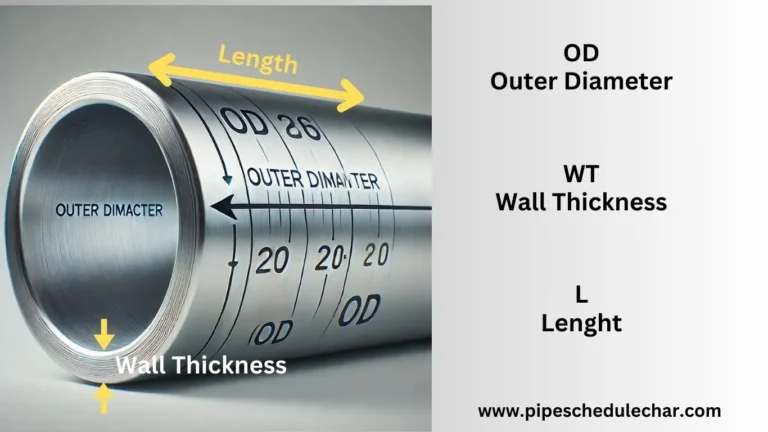
North American PEX is made to copper tube size (CTS) OD with an SDR 9 wall. This is the single most important fact for fitting compatibility: a 1/2″ PEX tube has the same 0.625″ OD as 1/2″ Type L copper — not the 0.840″ OD of 1/2″ NPS Schedule 40 steel or PVC pipe. If you normally work from a pipe schedule chart, keep this distinction front of mind.
| Nominal Size | OD (in) | Min. Wall (in) | Approx. ID (in) | Typical Use |
|---|---|---|---|---|
| 1/4″ | 0.375 | 0.062 | 0.25 | Ice makers, small instrument lines |
| 5/16″ | 0.430 | 0.064 | 0.30 | Radiant heating (in-floor PEX tubing) |
| 3/8″ | 0.500 | 0.070 | 0.36 | Fixture branches, radiant loops |
| 1/2″ | 0.625 | 0.070 | 0.485 | Fixture branches, home-run systems |
| 5/8″ | 0.750 | 0.083 | 0.584 | Radiant, hydronic loops |
| 3/4″ | 0.875 | 0.097 | 0.681 | Trunk lines, water service |
| 1″ | 1.125 | 0.125 | 0.875 | Water service, mains |
| 1-1/4″ | 1.375 | 0.153 | 1.069 | Commercial risers, mains |
| 1-1/2″ | 1.625 | 0.181 | 1.263 | Commercial mains |
| 2″ | 2.125 | 0.236 | 1.653 | Commercial mains, hydronic headers |
ID values are calculated from nominal OD minus twice the minimum wall; actual tube ID varies slightly by manufacturer.
Standard pressure ratings (ASTM F876 / PPI TR-4): 160 psi at 73 °F, 100 psi at 180 °F and 80 psi at 200 °F. The joint is only as good as the fitting system, so the fitting must carry the same ratings.
Metric PEX (15 mm, 16 mm, 20 mm)
Outside North America, 15mm PEX pipe (UK, typically 15 × 2.5 mm PEX-B) and 16 × 2.0 mm / 20 × 2.0 mm (EU and Asia) are standard. 15mm PEX fittings — for example JG Speedfit plumbing push-fit or Hep2O — are not interchangeable with 1/2″ CTS fittings, even though the sizes look close (15 mm vs 15.875 mm OD). Never mix metric and imperial PEX fittings.
2. PEX Connection Types Compared
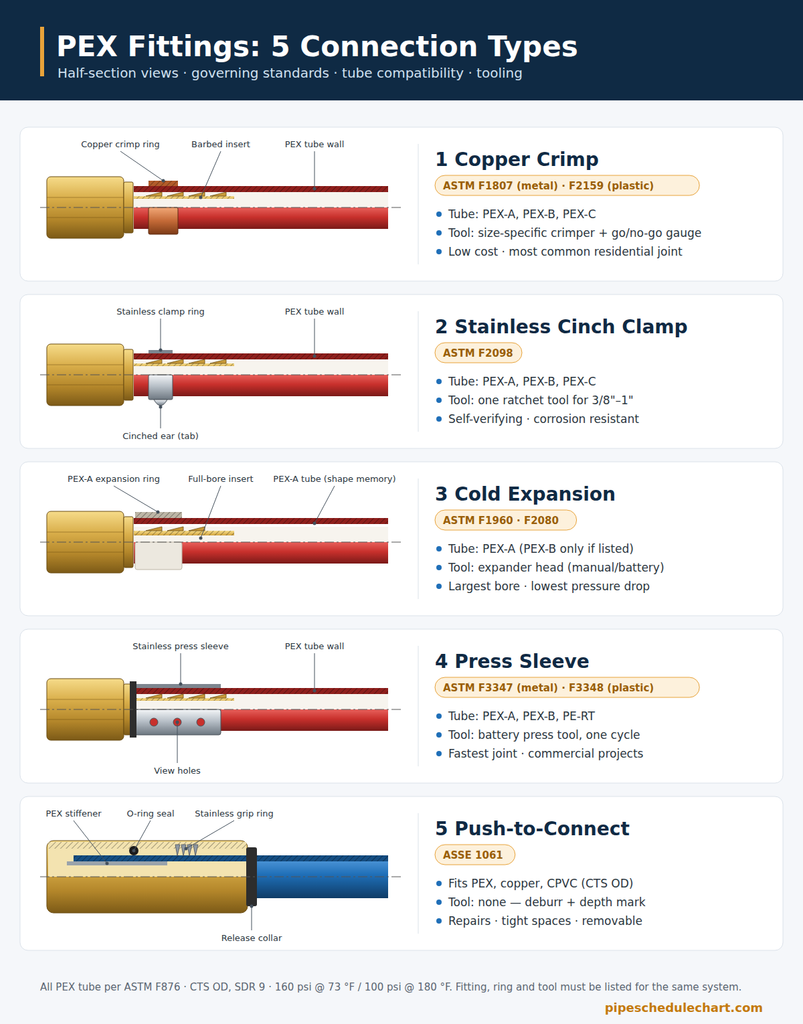
The table below summarises the main PEX fittings types and their governing standards.
| Connection Type | Standard | Ring / Sleeve | Tube Compatibility | Tool Required | Concealed Use |
|---|---|---|---|---|---|
| Copper crimp | ASTM F1807 (metal insert), F2159 (plastic insert) | Copper crimp ring | PEX-A, PEX-B, PEX-C | PEX pipe crimper + go/no-go gauge | Yes |
| Stainless cinch clamp | ASTM F2098 | Stainless steel clamp ring | PEX-A, PEX-B, PEX-C | Cinch/clamp tool | Yes |
| Cold expansion (PEX ring) | ASTM F1960 | PEX expansion ring | PEX-A (PEX-B only if listed) | Expander tool | Yes |
| Cold expansion (metal sleeve) | ASTM F2080 | Brass compression sleeve | PEX-A | Expander + sleeve tool | Yes |
| Press sleeve | ASTM F3347 (metal), F3348 (plastic) | Factory-fitted stainless press sleeve | PEX-A, PEX-B, PE-RT | Press tool | Yes |
| Push-to-connect | ASSE 1061 | Internal stainless grip ring + O-ring | PEX, copper, CPVC, PE-RT | None (deburr + depth gauge) | Per local code |
| Compression | Manufacturer / ASTM F1974 (PEX-AL-PEX) | Brass nut + ferrule + insert | PEX, PEX-AL-PEX | Wrenches | Usually accessible only |
All fittings for potable water should carry NSF/ANSI 61 and NSF/ANSI 372 (lead-free) listings, plus NSF 14 for plastics.
2.1 PEX Crimp Fittings and Crimp Rings
PEX crimp fittings are the most widely used system in residential plumbing because they are inexpensive and work on every PEX type. A barbed insert (brass or poly alloy) goes into the tube, a copper ring slides over the tube, and a PEX pipe crimper compresses the ring uniformly.
PEX crimp rings (usually called simply crimp rings or PEX rings — e.g., 1/2 PEX rings and 3/4 PEX rings) are annealed copper bands sized to the tube. Do not confuse them with PEX expansion rings, which are cross-linked polyethylene sleeves used only on F1960 fittings:
- 1/2 PEX crimp rings — for 1/2″ fittings (most common size)
- 3/4 PEX crimp rings / 3/4 crimp rings — trunk lines
- 1 PEX crimp rings — mains and water service
- 1 1/4 PEX crimp rings — light-commercial mains
Installation procedure (engineer’s checklist):
- Cut the tube square with a PEX cutter — never a hacksaw.
- Slide the ring on, then insert the fitting fully to the shoulder.
- Position the ring 1/8″ to 1/4″ from the tube end (not over the end of the tube).
- Crimp with the jaws square to the ring.
- Verify every joint with the go/no-go gauge. The ring must pass the GO slot and must not pass the NO-GO slot. A ring that is under- or over-crimped must be cut out.
A crimp PEX joint is permanent and suitable for concealed locations. Recalibrate full-circle crimpers periodically — out-of-calibration tools are the main cause of crimp failures.
2.2 PEX Cinch Clamp (Stainless Steel Clamp Rings)
The PEX cinch clamp (also sold as cinch clamp, ear clamp or PEX pipe clamps) uses a stainless steel band with a tab that is squeezed by a ratcheting tool. The same tool works across 3/8″ to 1″ sizes, which makes the 1/2 PEX clamp and 3/4″ clamp popular with installers who dislike carrying multiple crimp jaws. The ratchet only releases when full compression is reached, so no gauge is needed. Stainless clamps also resist external corrosion better than copper crimp rings in slab and damp crawlspace installations.
Note: “PEX pipe clamps” is also used for nail-on support clips that hold tube to joists. Supports should be spaced at approximately 32″ horizontally for 1″ and smaller tube, per most plumbing codes (verify locally).
2.3 PEX Expansion Fittings (ASTM F1960)
PEX expansion fittings — PEX-A expansion fittings in particular — exploit the shape memory of PEX-A. The installer slides a PEX expansion ring over the tube end, expands both tube and ring with an expander tool, and inserts the fitting. Within seconds (longer in cold weather) the tube shrinks back onto the barb and forms a joint that is actually tighter than the tube itself.
Engineering advantages:
- Full-bore flow — expansion fittings have a larger internal diameter than crimp inserts, reducing pressure drop by up to ~30% in small sizes.
- No metal ring to corrode.
- Tolerant of freeze cycles.
The leading system is Uponor ProPEX (ProPEX fittings / Uponor ProPEX fittings) used with Uponor PEX-A (AquaPEX) tubing; Uponor PEX fittings are also available in lead-free brass and engineered plastic (EP). Older installers still refer to them as Wirsbo fittings or Wirsbo PEX fittings, as Wirsbo was Uponor’s former North American brand name; the tube is the same AquaPEX fittings family. Rehau PEX fittings use either F1960 or the F2080 Everloc compression-sleeve system.
PEX-B and expansion: standard PEX-B does not have enough memory for F1960 joints. A few products (e.g., certain Zurn PEX-B expansion tube and fitting combinations) are specifically listed for F1960; only use expansion on PEX-B when both the tube and fitting carry that listing.
2.4 PEX Press Fittings
PEX press fittings combine a barbed insert with a factory-attached stainless steel sleeve. A battery press tool compresses the sleeve in one cycle. The best-known system is Viega PureFlow — Viega PureFlow fittings (and the older Viega PEX press fittings) used with Viega PEX pipe (ViegaPEX). A Viega PEX press joint is fast, visually verifiable (the sleeve has view holes and a press indicator) and suitable for commercial projects where labour speed matters. Uponor, Rehau and others also offer PEX press systems.
Press fittings are also the easy bridge to copper: a ProPress to PEX adapter (also written ProPress x PEX adapter, pro press to PEX or ProPress to PEX fittings) has a copper press end on one side and a PEX press, crimp or expansion end on the other. The 1/2 ProPress x PEX adapter (ProPress to PEX 1/2) is the most common size.
2.5 PEX Push-to-Connect Fittings (SharkBite, EvoPEX)
PEX push to connect fittings (also called PEX quick connect) need no tools apart from a deburrer and depth gauge. Inside, a stainless steel grip ring locks the tube and an EPDM O-ring seals it. They are listed to ASSE 1061 and are ideal for repairs, tight spaces and emergency work.
SharkBite PEX fittings are the dominant brand. Because PEX, copper and CPVC share the same CTS OD, one SharkBite PEX fitting fits all three — which is why the same part is sold as SharkBite copper fittings, copper SharkBite or SharkBite copper to PEX. When used on PEX, a plastic PEX stiffener (insert) must be in the fitting (pre-installed in brass SharkBite fittings).
Popular SKUs searched by installers:
- SharkBite 1/2 coupling / 1/2 inch SharkBite coupling (the classic repair coupling — also sold as a slip coupling)
- 3/4 SharkBite coupling and 3/4 SharkBite tee
- SharkBite elbow 1/2
- 1 inch SharkBite and 2 inch SharkBite (larger sizes for mains)
- SharkBite faucet connectors and valve adapters
- SharkBite PEX-A and SharkBite PEX pipe (the company also sells its own tubing)
SharkBite EvoPEX (EvoPEX, EvoPEX fittings, EvoPEX SharkBite) is a lower-cost plastic line designed specifically for PEX and PE-RT, with a visual connection indicator. Plastic SharkBite fittings such as EvoPEX are not intended for copper.
Polybutylene: grey polybutylene (PB) tube has a different OD tolerance and wall, so a standard fitting must not be used. Use a polybutylene SharkBite conversion coupling or a dedicated polybutylene to PEX adapter (also searched as poly to PEX adapter or polybutylene to PEX). Reducing versions exist for older supply lines, such as a 3/8 polybutylene to 1/2 PEX conversion. Brands such as Qest fittings historically served PB systems.
SharkBite clamps (also searched shark bite clamps) refers to SharkBite’s own crimp and clamp ring line, compatible with their PEX crimp and clamp fittings.
2.6 PEX Compression Fittings
PEX compression fittings use a nut, brass ferrule and internal insert. They are often used at fixtures, stop valves and on PEX-AL-PEX pipe. A copper to PEX compression fitting can transition two materials without tools beyond wrenches, but most codes restrict compression joints to accessible locations. Never use a plain copper compression fitting on PEX without the manufacturer’s PEX insert.
3. PEX Fitting Materials: Brass, Plastic and Stainless Steel
| Material | Typical Grade | Advantages | Limitations |
|---|---|---|---|
| Brass PEX fittings | Lead-free brass (e.g., C69300, C27450) or DZR brass | High strength, heat tolerant, compact | Dezincification in aggressive/low-pH water; cost |
| Plastic PEX fittings (poly alloy) | PPSU, PSU | Corrosion-proof, lightweight, lower cost, no scaling | Larger OD; avoid over-torquing threaded plastic adapters |
| Stainless steel PEX fittings | 304 / 316 SS | Best corrosion resistance, high-purity or aggressive-water service | Highest cost; limited availability |
| Copper | C12200 | Crimp rings, stub-outs, sweat adapters | External corrosion in wet environments |
Stainless PEX fittings are worth specifying where water chemistry is aggressive (high chloride, low pH) or where dezincification of brass has been a problem. In many parts of Pakistan, for example, high-TDS groundwater justifies DZR brass or PPSU over standard yellow brass.
4. PEX Fittings by Function
The following are the core PEX plumbing fittings and PEX pipe connectors found in any installation.
Couplings and Reducers
- PEX coupling — joins two tubes of equal size (1/2 PEX coupling, PEX coupling 1/2, 3/4 PEX coupling).
- PEX union — a coupling that can be disassembled, useful at equipment such as water heaters and pumps.
- Reducing couplings — 3/4 to 1/2 PEX reducer, 1 to 1/2 PEX reducer, and 3/8 to 1/2 PEX adapter.
Elbows and Bends
- PEX elbow / PEX 90 / PEX 90 elbow / PEX 90 degree elbow — available as 1/2 PEX 90, 1/2 PEX elbow (PEX elbow 1/2), 3/4 PEX 90, 3/4 PEX elbow and 1 PEX 90.
- A PEX 90 degree bend can often replace an elbow altogether by using a bend support. Minimum bend radius is typically 6 × OD for PEX-A and 6–8 × OD for PEX-B (check the manufacturer). Eliminating elbows removes a potential leak point and cuts pressure drop.
- Drop-ear elbows — the standard PEX shower head fitting, also used for tub spouts: 1/2″ PEX × 1/2″ FNPT with a mounting flange.
Tees
- PEX tee / PEX T / PEX T fitting — 1/2 PEX tee, 3/4 PEX tee, 1 PEX tee, and reducing tees such as 3/4 × 1/2 × 1/2.
- PEX monoflow tee — a diverter tee for single-pipe hydronic heating loops that forces a portion of the flow through each emitter.
- Copper to PEX tee — one leg sweat or press copper, the others PEX, handy when branching off an existing copper main.
Adapters
- PEX female adapter — PEX × FNPT, e.g., 1/2 PEX female adapter or 1/2 PEX to 1/2 NPT female; 3/4 PEX to 1/2 NPT female for reducing to valves.
- PEX male adapter — 1/2 PEX male adapter, 3/4 PEX male adapter, and 1 NPT to 3/4 PEX for water meter and water heater connections.
- PEX adapters for hoses — PEX to hose adapter, PEX garden hose fitting, 1/2 PEX to garden hose adapter, 3/4 PEX to garden hose adapter (female 3/4″ GHT). Also used for PEX hose fittings on flush and drain connections.
End Fittings and Accessories
- PEX cap — 1/2 PEX cap for capping future stubs and test sections.
- PEX stub out — a copper tube elbow (PEX × 1/2″ copper) that exits the wall for toilet and sink supplies, giving a rigid surface for compression stop valves.
- PEX faucet connector / 1/2 PEX faucet connector / PEX to faucet adapter — PEX to 3/8″ compression or 1/2″ FIP faucet tails.
- PEX water line fittings for refrigerators, ice makers and humidifiers (typically 1/4 PEX fittings and 3/8 PEX fittings).
5. Transition Fittings: Copper, PVC and CPVC to PEX
Transition fittings are where most field errors occur, because the engineer has to reconcile different sizing systems (CTS vs IPS) and different jointing methods.
Copper to PEX
Because copper tube and PEX share CTS OD, copper to PEX transitions are straightforward. Options:
- Copper to PEX adapter (sweat × PEX) — the 1/2 copper to PEX adapter and 3/4 copper to PEX adapter are the most common. Sweat the copper side before inserting PEX, or keep heat well away from the PEX.
- Copper to PEX fitting by push-fit — SharkBite copper to PEX couplings require no heat.
- Press — a ProPress to PEX adapter.
- Compression.
In reverse, the same part is sold as a PEX to copper adapter, PEX to copper fittings or PEX to copper connection. In all cases, a dielectric break is not required between PEX and copper, but maintain electrical bonding of metallic piping per the electrical code if the copper was previously serving as a bonding path.
PVC to PEX
PVC pipe is sized to IPS / NPS OD (e.g., 1/2″ Schedule 40 PVC = 0.840″ OD), whereas PEX is CTS. SharkBite fittings will not fit Schedule 40 or 80 PVC. A PVC to PEX adapter (or PEX to PVC adapter / PVC to PEX fitting) is therefore always a threaded or dedicated transition:
- PVC solvent-weld × FNPT adapter, then a PEX × MNPT adapter — e.g., a 1/2 PEX to PVC adapter, 3/4 PEX to PVC adapter or 1 PEX to PVC adapter.
- Dedicated PVC-to-PEX transition fittings (PVC socket × PEX barb) for cold-water service lines.
PVC is rated only to 140 °F and is not permitted for hot water distribution, so this transition is typically made on the cold water service entrance or irrigation. Check our PVC pipe schedule chart to confirm the OD before ordering.
CPVC to PEX
CTS CPVC shares the copper OD, so push-fit works directly. For solvent-weld systems, use a CPVC to PEX adapter (PEX to CPVC adapter, 1/2 CPVC to PEX adapter) — typically a CPVC socket × brass PEX insert, or a CPVC × FNPT transition to a PEX male adapter.
PEX-A to PEX-B
Since PEX-A and PEX-B share the same OD, a crimp, clamp, press or push-fit fitting joins them directly. A dedicated PEX-A to PEX-B adapter is only required when one side uses F1960 expansion (PEX-A only): it has an expansion end on one side and a crimp end on the other.
6. Manifolds and Distribution
Home-run (manifold) systems feed each fixture with a dedicated line, balancing pressure and allowing individual shut-off.
- Uponor PEX manifold — ProPEX outlet manifolds and engineered plastic (EP) manifolds.
- PEX expansion manifold — any manifold with F1960 outlets.
- Manabloc fittings / Viega Manabloc fittings — the Viega Manabloc is a parallel-port plastic distribution manifold with outlet adapters for 3/8″ and 1/2″ PEX.
- Radiant heating manifolds often use Euro-cone (EK) outlets, which require loop-specific compression adapters — for example a 1/2 PEX to EK20 loop fitting assembly — matched to the manifold manufacturer.
For in floor PEX tubing (radiant heating), always use PEX with an EVOH oxygen barrier (DIN 4726) when the system contains ferrous components, and 5/16 PEX fittings, 3/8 PEX fittings, 1/2 PEX fittings or 5/8 PEX fittings matching the loop size.
Insulated PEX (insulated PEX tubing) — PEX pre-sleeved with closed-cell foam or pre-insulated in a jacketed carrier — is used for buried district heating, hot water recirculation and outdoor lines. Standard fittings are used after stripping the insulation, with the joints wrapped afterwards.
7. Sizing Fittings by Size: 1/4″ to 2″
| Size | Common Fittings | Typical Application |
|---|---|---|
| 1/4 PEX fittings | Compression, push-fit | Ice maker and instrument lines |
| 5/16 PEX fittings | Expansion, compression | Radiant floor loops |
| 3/8 PEX fittings | Crimp, expansion, push-fit | Home-run fixture lines |
| 1/2 PEX fittings / 1/2 inch PEX fittings | Complete range (tees, 90s, adapters, caps) | Branch lines to fixtures |
| 5/8 PEX fittings | Expansion, crimp | Radiant and hydronic |
| 3/4 PEX fittings | Crimp, expansion, press | Main trunk lines, water heaters |
| 1 PEX fittings / 1 inch PEX fittings | Crimp, expansion, press, push-fit | Service entrance (1 inch PEX pipe) |
| 1 1/4 PEX fittings | Expansion, press, crimp | Commercial risers |
| 1 1/2 PEX fittings | Expansion, press | Commercial mains |
| 2 PEX fittings | Expansion, press | 2 in PEX pipe mains, hydronic headers |
For larger commercial sizes (1-1/4″ and up), expansion and press systems dominate, because crimp tooling becomes heavy and push-fit becomes expensive.
8. Brand Overview
| Brand | Tube | Primary Fitting System | Notes |
|---|---|---|---|
| Uponor (formerly Wirsbo) | PEX-A (AquaPEX) | Uponor ProPEX (F1960) | Uponor fittings include brass and EP plastic; industry benchmark for expansion |
| Viega | PEX-B (Viega PEX / PureFlow) | Viega PureFlow press, crimp | Viega PEX fittings; Manabloc manifolds; ProPress copper transitions |
| SharkBite | PEX-A & PEX-B | Push-to-connect, EvoPEX, crimp, clamp | Largest retail presence |
| Zurn | PEX-B | Crimp, clamp, expansion (listed systems) | Zurn PEX pipe and Zurn PEX fittings |
| Rehau | PEX-A | Everloc (F2080), F1960 | Strong in radiant heating |
| Apollo | PEX-B | Crimp, clamp | Apollo PEX fittings widely stocked |
| JG Speedfit | Metric PEX-B | Push-fit | Speedfit plumbing (15 mm, 22 mm) |
What are the best PEX fittings? There is no single answer. For new construction with PEX-A, F1960 expansion gives the best flow and freeze tolerance. For PEX-B on a budget, crimp or cinch is proven. For commercial speed, press. For repairs and awkward access, push-fit. The best PEX fittings are the ones listed for your specific tube and approved by the local authority having jurisdiction (AHJ).
9. Where to Buy PEX Supplies
PEX supplies and PEX plumbing supplies — tube, fittings, PEX parts and PEX accessories such as cutters, bend supports and deburring tools — are available through:
- Big-box retail — PEX fittings Home Depot and similar stores stock SharkBite, Apollo and Uponor ranges in 1/2″ to 1″ sizes.
- Plumbing wholesalers — supply house PEX fittings cover commercial sizes, press systems and full manufacturer ranges with technical support. For a quick local search, “PEX A fittings near me” usually points to wholesalers rather than retail.
- Bulk PEX fittings — contractor packs (e.g., 100-count crimp rings, 25-count tees) from wholesalers or online distributors reduce unit cost significantly.
When purchasing, confirm: (1) ASTM standard marked on the fitting, (2) NSF-61/372 listing, (3) compatibility with your tube type, and (4) that ring, fitting and tool belong to the same system.
10. Common Installation Mistakes (and How to Avoid Them)
- Mixing systems — using expansion fittings on non-listed PEX-B, or crimp rings on expansion fittings.
- No go/no-go check on crimp joints.
- Ring positioned over the tube end or too far back.
- Heat damage — soldering a copper adapter with PEX already attached.
- Using SharkBite on IPS pipe such as Schedule 40 PVC or steel.
- UV exposure — PEX must not be stored or installed in direct sunlight (most tubes allow 30–180 days max exposure).
- Direct connection to water heaters — most codes require 18″ of metallic pipe or a listed connector between a gas water heater flue and PEX.
- Tight bends without bend supports, causing kinks.
- Neglecting thermal expansion — PEX expands approximately 1.1 in per 100 ft per 10 °F rise; allow slack or expansion loops on long runs.
Frequently Asked Questions (FAQ)
Conclusion
Selecting PEX fittings is an engineering decision, not a shopping decision. Start with the tube type (PEX-A, PEX-B or PEX-AL-PEX), confirm the size system (CTS vs metric vs IPS), choose a connection method that suits the installation (crimp, cinch, expansion, press or push-fit), and verify that the fitting, ring and tool are listed together under the appropriate ASTM or ASSE standard. Get those four items right and a PEX system will deliver decades of leak-free service.
For wall thickness, OD and pressure data on steel, stainless, PVC and CPVC pipe you may be transitioning to or from, see our complete pipe schedule chart.